
How Often Should You Service Your Tires?
Your tires are the only thing connecting two tons of vehicle to the road, but they get less routine attention than almost any other major component on your car. The good news: tire maintenance follows a predictable schedule, and most of it takes minutes once you know what to check and when. Skip it and you’ll shorten tire life, hurt fuel economy, and quietly raise your stopping distance on wet roads.
Here’s a straightforward maintenance schedule for keeping tires in shape — built around what tire manufacturers, the National Highway Traffic Safety Administration (NHTSA), and AAA actually recommend. Whether you’re driving daily around Ontario or commuting across the Inland Empire, the cadence is the same.

At-a-Glance Tire Service Schedule
The full schedule below covers everything most drivers will ever need to know about tire service intervals. Each section that follows explains the why and how behind each line in the table.
| When | What to Check or Do | Why It Matters |
|---|---|---|
| Monthly | Tire pressure, visual inspection, penny test | Catches underinflation, damage, and early tread wear before they become dangerous |
| Every 5,000–7,500 miles | Tire rotation | Evens out wear patterns and extends overall tire life |
| Annually after year 5 | Professional tire inspection | Catches age-related rubber degradation that’s invisible from outside |
| 6–10 years from manufacture date | Tire replacement (regardless of tread depth) | Rubber compounds break down with age — old tires can fail with tread left |
| At 4/32″ tread depth | Plan replacement (AAA threshold) | Wet stopping distance increases sharply below this point |
| At 2/32″ tread depth | Replace immediately (California legal minimum) | Below this, wet stopping distance is roughly double that of a new tire |
Monthly: Pressure, Visual Check, and the Penny Test
The single most important habit is the easiest one: check your tires once a month. NHTSA recommends monthly inspections covering inflation, tread wear, and damage — a five-minute routine that prevents most of the problems that send drivers to the service bay early.
Tire Pressure (PSI)
Air pressure changes by roughly one PSI for every 10°F shift in ambient temperature. In Ontario, where summer afternoons routinely climb 30°F or more above overnight lows, that’s enough to push tires meaningfully out of spec across a single day. The correct pressure for your vehicle is on the placard inside the driver-side door jamb — never the maximum number printed on the tire sidewall, which is the tire’s ceiling, not your vehicle’s operating target.
Check pressure when tires are cold: parked for at least three hours, or driven less than one mile that morning. Driving heats tires up and inflates readings by several PSI, so checking right after your commute will give you a falsely high number.
If your vehicle is model year 2008 or newer, it has a Tire Pressure Monitoring System (TPMS) — a federal requirement on all passenger cars, light trucks, and vans built since then. TPMS is a safety net, not a replacement for a manual gauge. The warning light typically doesn’t trigger until pressure is already 25% below spec — well past the point where wear and fuel economy start suffering.
The Penny Test — and How It Compares to Other Methods
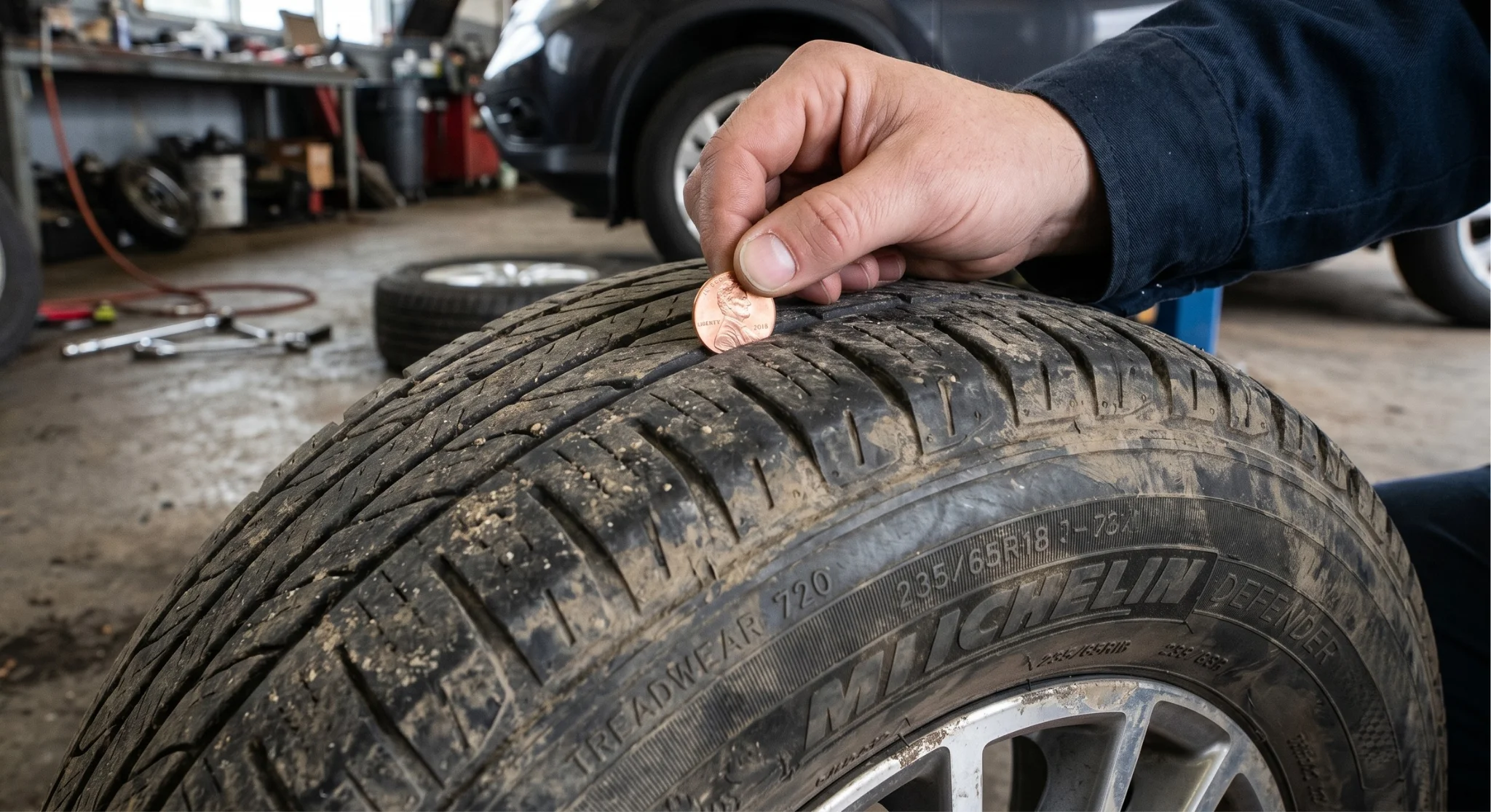
Hold a penny with Lincoln’s head pointed down and slide it into the tire’s tread grooves at the outer edge, center, and inner edge. If you can see the top of Lincoln’s head at any point, the tread is at or below 2/32 of an inch — California’s legal minimum, and the point at which wet stopping distance roughly doubles compared to a new tire.
| Method | Threshold Measured | Best Use |
|---|---|---|
| Penny test | 2/32″ (legal minimum) | Quick monthly check at home — Lincoln’s head visible means replace immediately |
| Quarter test | 4/32″ (AAA-recommended) | More conservative check — tread not reaching Washington’s head means plan replacement |
| Tread depth gauge | Exact depth in 32nds of an inch | Used in professional inspections for precise multi-point measurement |
Visual Check and Wear Pattern Diagnosis
Look for sidewall cracks, bulges, embedded nails or screws, and uneven wear patterns. The wear pattern itself usually points to the underlying problem:
| What You See | Likely Cause | What to Do |
|---|---|---|
| Wear on outer edges (shoulders) | Underinflation | Add air to door-jamb spec; check for slow leaks if it returns |
| Wear concentrated in the center | Overinflation | Release air down to spec |
| One side worn more than the other | Alignment out of spec | Schedule an alignment check |
| Cupping or scalloped wear | Worn suspension components (shocks, struts) | Have suspension inspected before more damage occurs |
Every 5,000 to 7,500 Miles: Tire Rotation
Why Rotation Matters
Tires don’t wear evenly. Front tires handle steering, most of your braking force, and — on front-wheel-drive vehicles — all of the power delivery, so they wear faster than rears. Without rotation, your fronts can be at replacement depth while your rears still have most of their tread left. You end up buying tires two at a time instead of four, which usually costs more over the life of the vehicle.
Rotation Intervals and Timing
Michelin’s standard recommendation is to rotate every 5,000 to 7,000 miles. Most vehicle manufacturers cite 5,000 to 7,500. The easiest way to remember it: rotate at every other oil change, or pair the rotation with each oil service if you’re on a 5,000–7,500 mile oil cycle.
Rotation Patterns by Drivetrain
The correct rotation pattern depends on your vehicle’s drivetrain and tire type. Your owner’s manual specifies the exact pattern for your model, but here’s the general framework:
| Drivetrain | Standard Rotation Pattern |
|---|---|
| Front-wheel drive | Rears move straight to front; fronts cross to the opposite rear position |
| Rear-wheel drive | Fronts move straight to rear; rears cross to the opposite front position |
| All-wheel drive / 4WD | All four tires cross in an X pattern |
| Directional tires (any drivetrain) | Front-to-rear only, same side of the vehicle — never crossed |
If you’re noticing uneven wear, vibration at highway speeds, or your vehicle pulling to one side, it’s time for a rotation — and probably an alignment check too.
Annually After Year 5: Professional Inspection
Why Visual Checks Aren’t Enough as Tires Age
A monthly visual check catches obvious problems. A professional inspection catches the ones that aren’t visible.
After about five years of service, tire manufacturers including Michelin recommend an annual professional inspection regardless of how much tread is left. The reason: tire rubber degrades through oxidation — exposure to air, sunlight, and heat causes the compounds to harden and crack from the inside out. That process can compromise structural integrity long before it shows up on the outside.
What’s Included in a Professional Tire Inspection
| What’s Checked | Why It Matters |
|---|---|
| Tread depth measured with a calibrated gauge at multiple points | More accurate than the penny test and catches uneven wear precisely |
| Sidewall integrity (cracks, bulges, embedded damage) | Sidewall failure is often catastrophic and typically can’t be repaired |
| Wear pattern analysis | Diagnoses alignment, suspension, or pressure issues at the root cause |
| Wheel and rim condition | Bent rims and corrosion cause slow air loss and ride vibration |
| Pressure verification against door-jamb spec | Catches slow leaks and seasonal pressure variation |
| Wheel balance evaluation | Prevents premature wear and steering-wheel shimmy at highway speeds |
How to Check Your Tire’s Age (DOT Code)
To check your tire’s age yourself, find the DOT code on the sidewall. The last four digits give the manufacturing date — the first two are the week, the second two are the year. A code ending in “0322” means the tire was built the third week of 2022. If you can’t find the full code on the outer sidewall, check the inner sidewall — some manufacturers stamp it there for production reasons.
6 to 10 Years: The Replacement Window
NHTSA’s TireWise guidance is direct: some vehicle and tire manufacturers recommend replacing tires that are six to ten years old, regardless of treadwear. Most tire manufacturers treat ten years as the maximum service life from the manufacturing date — at that point, replacement isn’t a recommendation, it’s a safety requirement.
In Ontario’s climate, plan toward the earlier end of that window. Continuous heat and sun exposure accelerate the oxidation process that ages tires. A set that might last ten years in a temperate, garage-kept environment can be effectively at end-of-life at seven or eight years under sustained Inland Empire sun — even if the tread depth still looks acceptable.
Don’t Forget the Spare
Full-size spares are NHTSA’s most-flagged aging risk because most drivers never replace them. If your vehicle is approaching its tenth year and you’ve never thought about the spare, check the DOT code. An aged spare can fail when you need it most. The practical rule: between years six and ten, age becomes the deciding factor in replacement timing — not tread depth.
Schedule Your Next Tire Service at JCO of Ontario
Tire service is one of the simplest maintenance categories to stay ahead of: monthly pressure checks at home, rotation every other oil change, and a professional inspection once a year after year five. The team at Jeep Chrysler Dodge RAM FIAT of Ontario handles tire rotation, pressure adjustment, inspection, and replacement at our service center on Auto Center Drive — with certified technicians who work on Chrysler, Dodge, Jeep, RAM, and FIAT vehicles every day.
Disclaimer: Tire service intervals and maintenance recommendations in this article are general guidelines based on industry sources including NHTSA, AAA, and major tire manufacturers. Specific recommendations vary by vehicle make, model, year, tire type, and driving conditions. Always consult your vehicle’s owner’s manual and the tire information placard inside the driver-side door jamb for model-specific specifications. The penny test and other at-home checks are useful preliminary tools but do not replace a professional inspection. For any safety concerns, unusual wear, or to schedule a comprehensive tire inspection, contact the service team at Jeep Chrysler Dodge RAM FIAT of Ontario at 909-321-9772.